
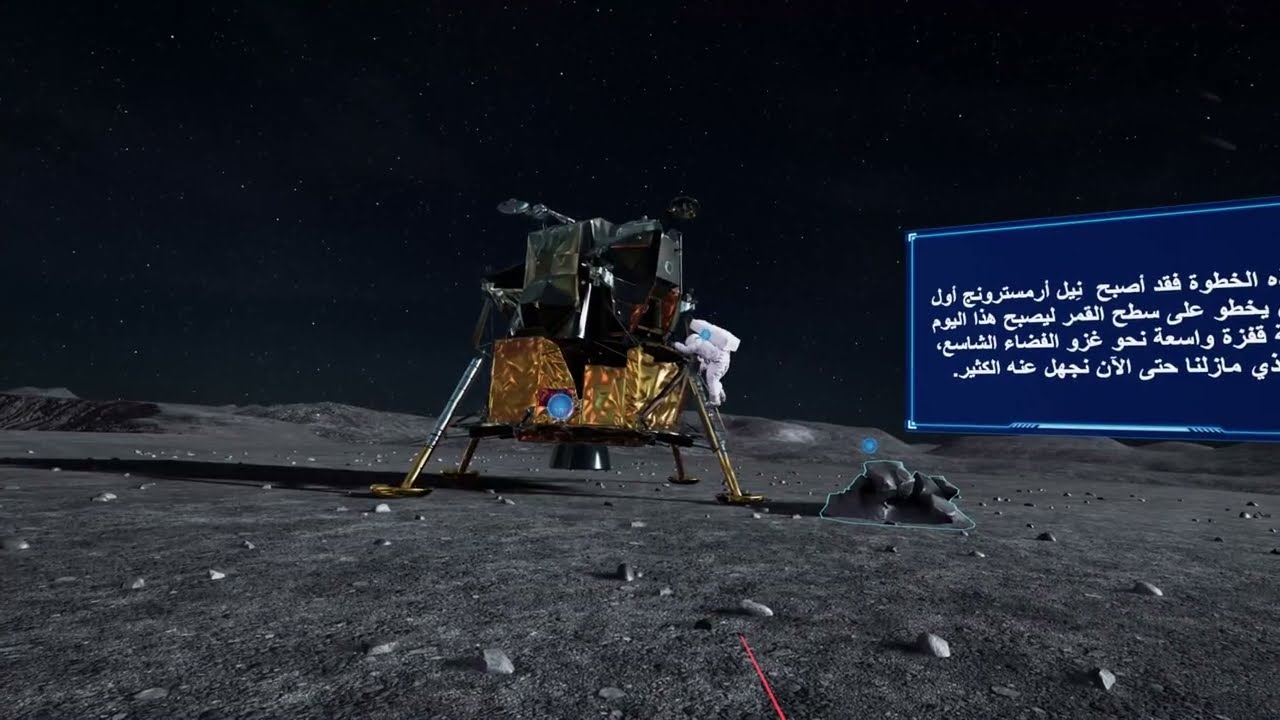
Apollo 11 — step onto the moon, in VR.
The brief
Apollo 11 was the most-watched moment in human history. Six hundred million people watched the live broadcast in 1969 — but they watched on tube TVs, in grainy black and white, from a distance of 384,400 kilometres. Today's students learn about it from a textbook paragraph or a museum diorama.
We rebuilt the mission as a real-time interactive virtual tour for educational exploratory centres. Visitors put on a Meta Quest 2 and stand on the launchpad as Saturn V ignites, ride inside the command module through trans-lunar injection, descend with the LM to the Sea of Tranquillity, and step out onto the lunar surface — at the actual location, in the actual lighting, with Earth visible in the sky.
The result is a teaching tool that turns abstract history into something you stand inside. Used by science centres and educational programmes to give students a felt understanding of what space exploration is — and what it cost to do it the first time.
Watch it in action
Key facts
- MissionApollo 11 (1969)
- HeadsetMeta Quest 2
- EngineUnreal Engine 4
- FormatReal-time virtual tour
Our approach
- 01Mission research and historical reference work — NASA archives, mission timeline, EVA transcripts.
- 02High-fidelity 3D modelling of Saturn V, command/service module, lunar module, and the Sea of Tranquillity surface.
- 03Real-time lighting and physically-based shading in Unreal Engine 4 — including the iconic lunar low-angle sun.
- 04Interactive event choreography — launch ignition, stage separation, lunar descent, EVA walk.
- 05Standalone build and deployment to Meta Quest 2 headsets for educational venues.
- 06Operator briefing and venue handoff (volume, audio cues, restart protocol).
Tools & hardware
- Meta Quest 2Standalone VR headset, 6DoF tracking
- Quest 2 Touch controllersInteraction with mission events